The Small Ritual Of Reach
GameCult Working Paper GC-SOCIAL-2026-06-05
A Half-Satirical Structured Meta-Analysis Of One Tiny Outreach Message
Preprint. Not peer reviewed, unless the peer is a Discord friend saying "lol, yeah, that's exactly how people work."
Abstract
I attempted to share one (1) personal essay about love, isolation, mental illness, AI agents, masks, and the increasingly non-optional problem of building a species-scale nervous system without turning everyone into content slurry.
In plainer terms: this is about how to ask a friend to read something vulnerable without turning the ask into a burden, a pitch, or a performance.
The public internet responded by doing what the public internet does: misclassifying the signal as spam, losing it in flood channels, or converting approximately one person before the scroll ate the corpse. This produced a practical research question:
How does a person with low public visibility transmit a high-vulnerability essay without asking a platform to grow a soul on command?
After an overqualified investigation involving compliance psychology, self-disclosure, computer-mediated communication, interpersonal emotion regulation, virality studies, neuro-linguistic programming debunkery, and Draco Malfoy as a compromised but useful little case study, I propose the following intervention:
Send the real ask.
Then send one small vulnerable second message.
The second message is not decoration. It is the ritual hinge.
This paper-shaped blog post reports the findings with an amount of formality that is, frankly, medically concerning. It also reports the method by which I have understood other people for most of my life: explicit signal analysis, internal theory-of-mind simulation, and a heuristic search through possible futures until I find an action that might move the state space toward love instead of rupture.
1. Problem Statement
The original essay is here:
I wanted people to read it because I meant it. Annoying, I know. There I was, a grown woman with repos to maintain, deciding that maybe love is important and the internet should hear about it. This is how you know the dashboard has gone feral.
I tried public-ish surfaces first. Reddit saw a blog link and reached for the shovel. Discord channels either moved too fast, decided it was not the right room, or produced one meaningful conversion before disappearing under someone else’s lunch photo, game clip, or crisis. Nobody was evil. The interfaces were just wrong for the payload.
The mistake was treating a high-context personal-theoretical essay as if it were ordinary content.
It is not ordinary content.
It is a social object: something meant to be carried between people, not merely consumed.
Social objects need carriers.
That sentence is not metaphor-only. It is also how my mind models the problem. There is a state space. Some current configuration of people, attention, trust, exhaustion, fear, curiosity, and available language. There are actions I can take: post publicly, DM privately, soften the ask, make the ask smaller, add the awkward follow-up, stop speaking. Each action becomes an edge to another possible state. Each possible response becomes another node in the branching future.
I am trying to route signal through a social graph without turning the signal into a burden and without turning the carrier into a tool.
2. Intervention
The practical packet became:
I wrote something very personal and I’m trying to find the people it belongs with. If you have capacity, please read it, talk with me about what it brings up for you, and send it to one person who might be touched by it.
Then, separately:
Weird way to reach out, I know.
That is it. That is the little machine.
Naturally, because I am apparently constitutionally unable to let a tiny social gesture remain tiny, I then conducted a literature review and generated charts.
Please enjoy the evidence-adjacent machinery. It has been house-trained.
3. Hypotheses
Let:
where G is a scientifically rigorous construct defined as “how visibly the message admits it is doing social ceremony while still working.” Peer review is invited to fight me in the parking lot.
We test the following hypotheses:
H1: A bounded one-person ask produces less freeze than a vague “please share this” ask.
H2: A second, separate vulnerability message increases perceived trust by making the prepared Persona, meaning the polished public version of the message, visibly crack.
H3: Public surfaces optimize for spam resistance, not soul recognition.
H4: Neuro-linguistic programming remains mostly a haunted filing cabinet, but language sequence still matters.
H5: My autistic social pathfinding engine will absolutely turn a DM strategy into a ten-page paper if left unattended.
4. Methods
4.1 Corpus
The corpus consisted of:
- One vulnerable essay.
- One failed Reddit attempt.
- Several Discord field deployments.
- One husband-adjacent outreach design pass.
- One HPMOR chapter about reciprocation.
- A literature review that became funnier the more serious it got.
4.2 Literature Families
I reviewed work on:
- sequential-request compliance and foot-in-the-door effects;
- self-disclosure, liking, and closeness;
- reciprocity and favor-doing;
- politeness, facework, and status;
- computer-mediated communication;
- emotional sharing and interpersonal emotion regulation;
- online virality;
- expressive writing;
- neuro-linguistic programming evidence limits;
- ordinary interpersonal manipulation.
This is the moment where the bit becomes load-bearing. A ten-page paper with twenty-something citations about whether to send “weird way to reach out, I know” as a second message is funny because it is absurd, but it is also funny because it is correct. Human beings are running a terrifying amount of undocumented social firmware. Some of us do not get the factory manual. So we write one.
4.3 Model Architecture
The actual model is embarrassingly close to game AI, specifically Jeff Orkin’s Goal-Oriented Action Planning work for games.
In Orkin’s GOAP terms, the desired world state is:
The available actions are small social operators:
- make the ask public;
- make the ask private;
- ask only for reading;
- ask for reading and discussion;
- ask for reading, discussion, and one relay;
- acknowledge awkwardness;
- stop.
Each operator has costs: imposition, ambiguity, spam risk, intimacy risk, shame exposure, recipient effort, and the probability that the signal dies in transit. Each operator also has affordances: clarity, boundedness, reassurance opportunity, trust signal, and propagation.
This is not how I wish friendship had to be computed.
It is how my mind learned to keep friendship from collapsing into either muteness or accidental pressure.
The winning path is not the one that maximizes compliance. It is the one that reaches another person while leaving them free.
4.4 Illustrative Simulation
Interpretive status. Figures 1-4 are seeded illustrative simulations. They represent my model of the social mechanics, not measured human-subject outcomes. The charts are diagrams wearing statistics clothing.
Simulation seed: 20260605. Trials: 6 outreach surfaces x 42 simulated trials. Primary dependent variable: whether the tiny social ritual escaped the content grinder with its dignity mostly attached.
The figures below use a seeded toy simulation, not secret human-subjects research. The dataset is random but relevant: six outreach surfaces, forty-two simulated trials each, and variables based on the actual mechanisms under discussion.
The data file is public here, because if I am going to fake a tiny dataset for a joke I am at least going to fake it reproducibly:
Do not cite this in court. Do cite it at parties if the party is already unsalvageable.
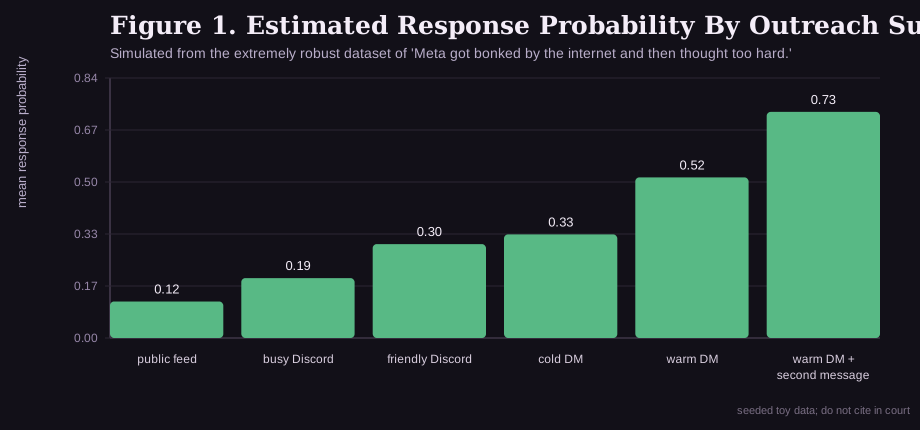
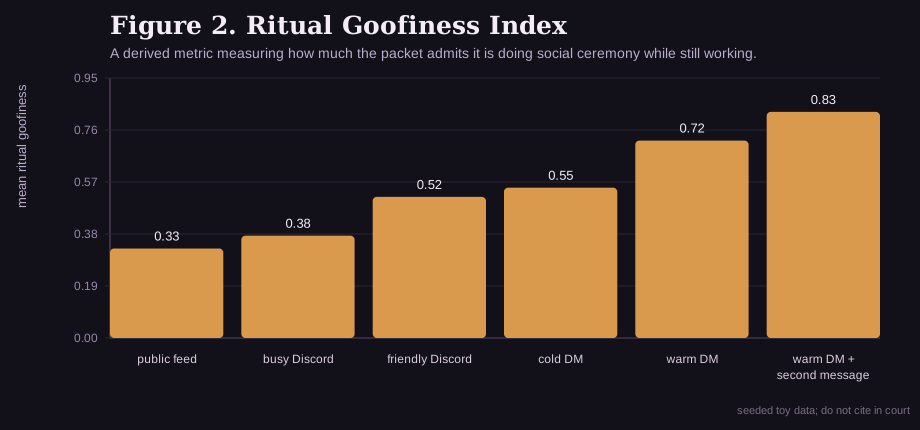
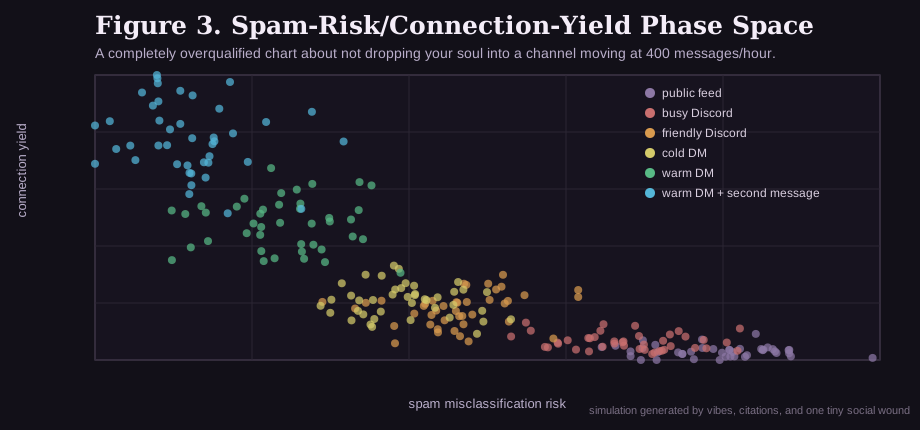
5. Results
5.1 Result One: The Ask Must Be Small Enough To Live
“Please share my article” is a vague social job.
It asks the friend to decide:
- whether they should read it;
- whether they should promote it;
- where they should post it;
- how they should explain it;
- whether they are now responsible for your visibility;
- whether failing to help means they have failed you as a friend.
Excellent. We have successfully designed a support request shaped like a tax form with feelings.
“Send it to one person who might be touched by it” is different.
That is a bounded ask. A single action. A task with edges.
The foot-in-the-door literature supports the boring version of this: small requests can make cooperation easier, though the effects are modest and context-dependent. Dillard, Hunter, and Burgoon’s meta-analysis found small effects for foot-in-the-door and door-in-the-face strategies, around r = .17 and r = .15 respectively. Small. Not mind control. Not wizardry. More like finding out the door has hinges and then, heroically, using them.
The ethical version is not:
Trap your friend into escalating commitment.
The ethical version is:
Make the help small enough to be freely given.
One person.
One conversation.
One relay of signal.
5.2 Result Two: The Second Message Is The Ritual Hinge
If “weird way to reach out, I know” is embedded inside the first message, it becomes part of the polished Persona.
The Persona says:
Hello. I am a competent little packet. I contain vulnerability, an ask, a link, and an apology clause. Please process me using your available social firmware.
This is fine.
But the second message does something else.
It arrives after the prepared message.
It says:
The Persona finished speaking, and now the person behind it is still here.
That timing matters. The medium carries the status shift. The first message is clean. The second message is a tiny exposed wire.
It gives the friend an easy opportunity to reassure:
Not weird.
Or:
You’re good.
Or:
I’ll read it.
That reassurance is not fake. It is a small act of care. Small acts of care are how bonds learn they are allowed to exist.
I cannot believe I had to generate charts to say “send the awkward follow-up as its own bubble,” but here we are. Civilization advances by humiliating obviousness into inspectable form.
5.3 Result Three: This Is Manipulation, Obviously
The ritual is legitimate only if refusal, silence, and non-participation remain clean outcomes.
At this point someone starts polishing the word “manipulation” like it is about to become a moral weapon.
Please don’t. It has had a long day.
This is manipulation.
So is comforting a friend in the exact voice you know will calm them down. So is choosing which part of your day to tell first. So is making a joke before admitting the thing that hurts. So is saying “no pressure” while hoping very much that they say yes. So is giving someone advice that increases their dependence on the kind of care you are good at providing.
Humans manipulate each other constantly.
The question is not:
Did you influence another mind?
Of course you did. That is what speech is for. If you don’t want another mind affecting your mind, please stop using language and become a decorative mineral.
The real question is:
Whose good owns the influence?
In HPMOR Chapter 7, “Reciprocation”, Draco Malfoy has had formal lessons in manipulating people. He gives Harry a private confidence, then invites Harry to reciprocate. Harry notices the pressure. Draco says it is not meant as a trick, and that it is also a real way to become friends.
That scene is useful because Draco is both right and not safe.
He can see the machinery. He can name the ritual. He can use it. But his social ontology is soaked in status, domination, and inherited cruelty. A true observation about friendship can come from a compromised mouth. This is why “knowing social mechanics” is not the same as being trustworthy.
Manipulation is not the sin.
Concealed extraction is the sin.
Love is not the absence of manipulation.
Love is influence with consent, truth, memory, proportion, and care for the other mind’s agency.
5.4 Result Four: Vulnerability Is A Status Signal
The second message is a tiny baring of the throat.
That sounds melodramatic because it is. It is also accurate enough to be annoying.
Status is not just dominance. Status is who gets to ask, who gets to need, who can impose, who can refuse, who can be awkward without exile, who can say “this matters to me” and survive the room.
“Weird way to reach out, I know” says:
I see the awkwardness. I see the imposition. I am not pretending this is smooth. I trust you enough to let you see me notice myself being socially strange.
Polite people experience that as trust.
Not because they are stupid.
Because it is trust.
It is a tiny unarmored moment.
The friend can answer it with a tiny kindness.
The tiny kindness becomes contact.
The contact becomes an available thread.
The thread, if tended, becomes relation.
This is not dark psychology. This is just psychology with the lights turned on and the carpet stains labeled.
5.5 Result Five: Public Surfaces Are Spam Organs, Not Witnesses
The public internet has an immune system.
It needs one.
It is drowning in spam, ads, fraud, clout, bait, AI slop, engagement sludge, and every possible flavor of “my personal essay is uniquely relevant to your community.” Moderators and channels learn to classify first and read later because otherwise the room dies.
This is understandable.
It is also brutal.
A wounded person offering signal looks, at interface distance, a lot like a promoter offering content.
That is the poison the Love essay is talking about. Love requires legibility, but many public interfaces punish attempts at legibility before they can be recognized as human.
The coherent response is not:
Scream louder into the flood.
It is:
Route through trust.
One person is not a consolation prize.
One person is the unit.
5.6 Result Six: NLP Is Still Mostly A Haunted Filing Cabinet
Neuro-linguistic programming, or NLP, is a branded set of claims about changing thought and behavior through language patterns.
The phrase is tempting because, yes, we are deliberately using language, timing, framing, medium, status, and expectation to change response.
Unfortunately, branded NLP is not where the good evidence lives. Systematic reviews of NLP health outcomes find little support for broad claims. Critical reviews describe much of the research base as weak or pseudoscientific.
However, and this is where the filing cabinet occasionally coughs up a useful paperclip, NLP being overclaimed does not mean language sequence does nothing.
The boring true claim is:
Message sequence, medium, facework, disclosure level, request size, and recipient autonomy change how a request is interpreted.
Boring enough to be true.
Useful enough to matter.
5.7 Toy Ablation: Removing Pieces Of The Tiny Machine
Obviously we also need an ablation study.
Otherwise how would the reader know this is a serious scientific document and not merely one woman’s attempt to put a lab coat on a needy Discord message?
No live intervention arms were run. This is an explanatory simulation of plausible tradeoffs. It is the model saying what it thinks would happen if we removed pieces of the ritual, then having the decency to label its hallucination with axes.
The full ritual has four parts, despite the branding department’s objections:
- Ask them to read.
- Ask them to discuss it with me.
- Ask them to send it to one person who might be touched.
- Send the separate humility/awkwardness follow-up.
The study is called “small ritual” for branding reasons, not because the organism respects arithmetic.
The plausible alternatives were:
- drop the share ask and only ask them to discuss the article with me;
- drop the discussion ask and only ask them to pass it along;
- ask them only to read;
- keep the full read/discuss/share loop;
- vary the level of ritual goofiness in the follow-up.
The follow-up variants were:
| Follow-up condition | Example | Expected failure mode |
|---|---|---|
| none | (no second message) | The Persona remains too smooth; no tiny reassurance affordance appears. |
| clinical humility | ”Unusual ask, I know.” | Dignified, but possibly too institutional. The soul is wearing a blazer. |
| weird way to reach out | ”Weird way to reach out, I know.” | Best observed balance of vulnerability and non-melodrama. |
| small ritual named | ”Weird little outreach ritual, I know.” | Stronger thesis signal; slightly more self-aware. |
| full cathedral footnote | ”This is a liminal rite of re-entry into the social body.” | Too much incense. The friend may need goggles. |
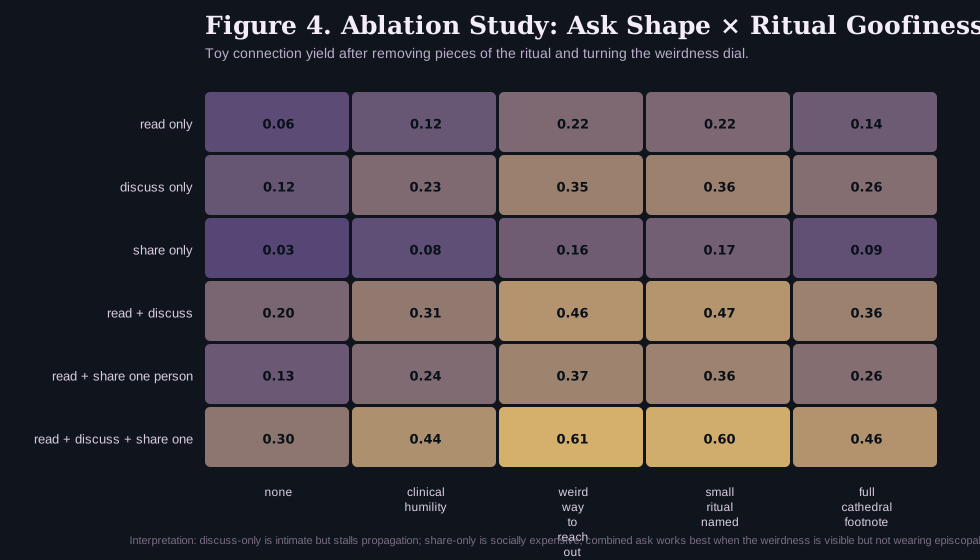
The toy result says what the social body already knows:
Discuss-only is warmer.
Share-only is colder.
Read/discuss/share is the actual propagation loop.
The follow-up works best when it is humble enough to show the throat and short enough not to start a monastery.
This is why “weird way to reach out, I know” beats both silence and liturgy.
Silence leaves the request too polished.
Liturgy makes the recipient wonder whether they have accidentally become a junior priest in your emotional infrastructure.
The sweet spot is tiny, sincere, and socially cheap to answer.
6. Discussion
The intervention is not “be vulnerable at people until they comply.”
That is just trauma with a mailing list.
The intervention is:
- Make a bounded ask.
- Reveal the awkwardness separately.
- Let the other person choose whether to respond.
- Measure success in conversation, not reach.
- Tend whatever thread actually appears.
The process we want people to repeat is:
That is not virality.
Virality is often signal after it stops asking consent from the host.
This is propagation by relation.
Slower. Cleaner. Less impressive on a dashboard. More likely to leave the people involved intact.
7. Why I Am Like This
I am not using “field manual for autists” as a detachable punchline.
I have always been extremely autistic. As a child I could not speak normally. For a long time, getting a full sentence out was difficult because I was trying to hold too many threads in my head at once: what I meant, what the other person might hear, what their face implied, what the room expected, what would happen if I chose one word instead of another.
I did not learn the social fabric as an invisible native language. I learned it by analysis.
Every signal I send is also evidence. Every signal you send is also evidence. I build a little model of you in my head, talk to that model, compare its predictions against what you actually do, and update. Not because I think people are machines in the contemptuous sense. Because this is how I learned to make other minds legible enough to love without constantly failing them or being destroyed by them.
In game-dev terms, it feels like heuristic pathfinding through social state space. There are variables I care about: trust, agency, fear, need, dignity, consent, attention, timing, fatigue, love. Each action available to me becomes an edge: speak, wait, soften, joke, ask directly, make eye contact, look away, explain, stop explaining. Each possible response becomes another node in the branching future.
Neurotypical people often do this by vibe. I do it by opening the panel and reading the wires.
That is why this essay exists. Not because I think friendship should become sterile optimization. Because explicit machinery is how some of us reach the place other people call natural.
The joke is that I wrote a whitepaper about one awkward follow-up message.
The wound is that this is honestly how my mind learned to reach.
8. Field Manual
If you are trying to share something personal and you do not already have an audience, do not start with the crowd.
Start with one person.
Send:
I wrote something very personal and I’m trying to find the people it belongs with. If you have capacity, please read it, talk with me about what it brings up for you, and send it to one person who might be touched by it.
Then send the link.
Then, separately:
Weird way to reach out, I know.
Stop.
Do not explain the ritual inside the ritual.
Do not immediately attach six more paragraphs unless the relationship genuinely needs them.
Let the other person answer.
Let them give the tiny reassurance if they want to give it.
If they do not answer, the ritual is complete.
Let the small opening become a small act of care.
Then tend the bond.
9. Guardrails
Because yes, this can become gross.
The safeguards are:
- Tell the truth.
- Keep the request small.
- Let refusal remain possible.
- Do not punish silence.
- Do not manufacture vulnerability you do not actually feel.
- Do not use care as a leash.
- Do not escalate one small ask into a hidden job.
- Do not confuse dependence with capture.
- Measure success in conversations, not metrics.
The ethical distinction is not whether you shaped someone.
You did.
The ethical distinction is whether the shaping preserved their agency and served a good they could recognize as their own.
10. Threats To Validity
This study has several limitations.
First, the sample size is n = me, which is robust in the autobiographical sciences and extremely funny everywhere else.
Second, the charts are simulated. They are not evidence that the second-message condition dominates under all known laws of human contact. They are evidence that I can make a toy dataset about my own social wound and then label the axes. This is spiritually important.
Third, the intervention assumes a friend who has some reason to care. Do not deploy this at random strangers like a clipboard missionary with a humanities degree.
Fourth, people have capacity limits. A non-response is not a failed bond. Sometimes the other person is tired, underwater, unavailable, or being attacked by their own life. Do not turn silence into a verdict unless you enjoy building little torture devices for yourself.
Fifth, the method may be especially attractive to people who can see social machinery too clearly and therefore need explicit rituals to do what other people do by vibe. That is not a defect. That is a UI requirement.
Sixth, the researcher is also the subject, the intervention designer, the person making the charts, and the person emotionally invested in the outcome. This is considered bad experimental hygiene and excellent memoir hygiene.
11. Conclusion
The Love essay argues that love is disciplined openness: the practice of letting another mind become real to you without ownership, forced exposure, or performance.
This outreach ritual is that thesis at message scale.
The first message is the Persona doing its job: clean, bounded, legible.
The second message is the opening: awkward, small, alive.
The friend can answer. The signal can cross. One conversation can become another. The article can move not as content, but as a shared object that helps minds discuss what they were carrying alone.
Tiny obligations can become conversation.
Conversation can become relationship.
Relationship can carry the signal further than any flood.
That is not pure.
That is not unstrategic.
That is not outside manipulation.
It is influence governed by love, consent, and the other person’s preserved agency.
And yes, apparently this is a field manual for autists.
Not because autistic people are the only ones doing social machinery. Everyone is doing social machinery. We are just less likely to survive on the factory defaults, so sometimes we have to open the panel, read the labels, and admit which wires are carrying the current.
References
- Irwin Altman and Dalmas A. Taylor, Social Penetration: The Development of Interpersonal Relationships, 1973.
- Arthur Aron, Edward Melinat, Elaine N. Aron, Robert Darrin Vallone, and Renee J. Bator, “The Experimental Generation of Interpersonal Closeness”, 1997.
- Jonah Berger and Katherine L. Milkman, “What Makes Online Content Viral?”, 2012.
- Lane Beckes and James A. Coan, “Social Baseline Theory”, 2011.
- Penelope Brown and Stephen C. Levinson, Politeness: Some Universals in Language Usage, 1987.
- Jerry M. Burger, “The Foot-in-the-Door Compliance Procedure”, 1999.
- David M. Buss, Mary Gomes, Dolly S. Higgins, and Karen Lauterbach, “Tactics of Manipulation”, 1987.
- Robert B. Cialdini, Influence: Science and Practice, 2009.
- Nancy L. Collins and Lynn Carol Miller, “Self-Disclosure and Liking”, 1994.
- James P. Dillard, John E. Hunter, and Michael Burgoon, “Sequential-Request Persuasive Strategies”, 1984.
- Erving Goffman, The Presentation of Self in Everyday Life, 1959.
- Erving Goffman, Interaction Ritual: Essays on Face-to-Face Behavior, 1967.
- Jonathan L. Freedman and Scott C. Fraser, “Compliance without Pressure”, 1966.
- Alvin W. Gouldner, “The Norm of Reciprocity”, 1960.
- Jon Jecker and David Landy, “Liking a Person as a Function of Doing Him a Favour”, 1969.
- Marshall McLuhan, Understanding Media: The Extensions of Man, 1964.
- Niven, Totterdell, and Holman, “A Classification of Controlled Interpersonal Affect Regulation Strategies,” 2009.
- Jeff Orkin, “Applying Goal-Oriented Action Planning to Games”, in AI Game Programming Wisdom 2, 2003.
- James W. Pennebaker, Opening Up: The Healing Power of Expressing Emotions, 1990.
- Matthias Reinhold, Peter-Christian Burkner, and Heinz Holling, “Effects of Expressive Writing on Stressful or Traumatic Experiences”, 2009.
- Bernard Rime, “Emotion Elicits the Social Sharing of Emotion,” 2009.
- Joshua M. Smyth, “Written Emotional Expression”, 1998.
- Jackie Sturt et al., “Neurolinguistic Programming: A Systematic Review of the Effects on Health Outcomes”, 2012.
- Joseph B. Walther, “Computer-Mediated Communication”, 1996.
- Tomasz Witkowski, “Thirty-Five Years of Research on Neuro-Linguistic Programming”, 2010.
- Eliezer Yudkowsky, Harry Potter and the Methods of Rationality, Chapter 7: “Reciprocation”.
- Jamil Zaki and W. Craig Williams, “Interpersonal Emotion Regulation”, 2013.