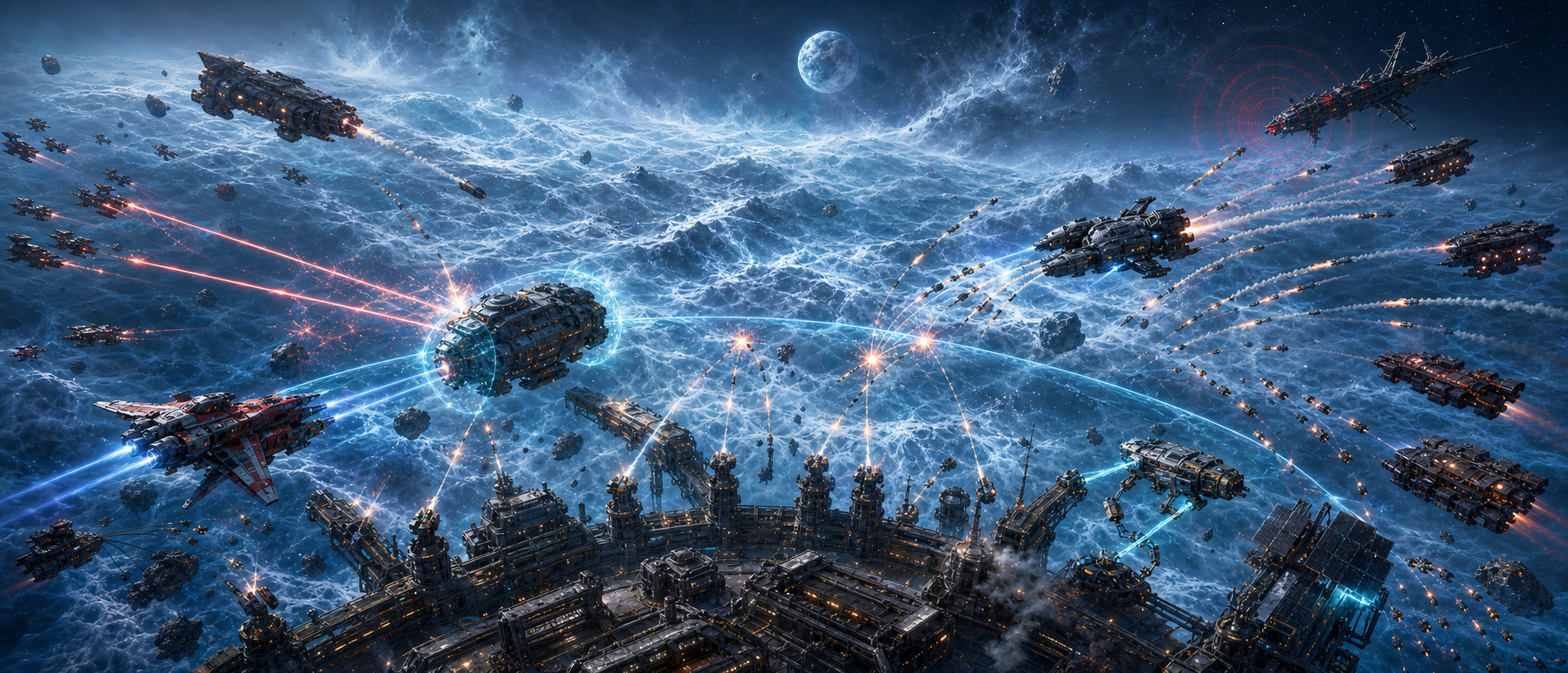
Aetheria has always pulled toward too much at once: fast ships, strategic maps, a living economy, faction pressure, salvage stories, and the MMO-sized dream behind them.
The current direction is Aetheria: Starbridge: a 2-5 player asymmetric co-op defense game, built as a tiny public proof of CultMesh running Aetheria state in trusted co-op mode.
One player commands a frontier base from a browser RTS interface. The other players fly ships in the Unity client. Everyone is inside the same battle from a different seat.
One base. One crew. One player sees the whole war. The others are in it.
The commander routes power, expands infrastructure, fabricates weapons, assigns drones, deploys turrets, watches bomber vectors, and reads the battle as a map.
The pilots thrust, dodge, shoot, overheat, dock, refit, recover salvage, anchor field structures, cool overloaded systems, repair exposed modules, and make the urgent close-range saves the commander cannot make from the chair.
The base survives only if both games cooperate. Starbridge puts two games on the same war machine: the command map with its power routes and fabrication queues, and the cockpit view where somebody has to fly through the mess.
The commander sees the shape of the battle without hands on the field. The pilots have hands on the field without the full picture. Communication becomes the main mechanic.
The best Starbridge moments should sound like this:
- “Hold north for ten seconds. I can get the shield back.”
- “Mark that bomber. I have a targeting window.”
- “Do not chase the scouts. I need salvage at the fabricator.”
- “I am dropping a turret frame. Someone anchor it.”
- “Your reactor is cooking. Dock or get a coolant beam on you.”
It is also the smallest honest proof of CultMesh.
Trusted Co-op First
The witness-authoritative article talks about the larger CultMesh dream: witnesses, contested facts, and dense worlds. Starbridge starts smaller: trusted co-op.
There is no adversarial peer handling in the first release target, no PvP, no MMO persistence, and no broad witness quorum. The point is simpler and more useful:
Can Aetheria run as a shared Verse where different runtimes author different parts of the same game?
In Starbridge, the browser RTS runtime naturally authors base infrastructure, fabrication, drone and turret orders, wave state, and tactical claims. Unity pilot runtimes naturally author responsive ship movement and immediate combat claims. Station stock, docking, ship state, and loadout changes remain typed Verse state instead of private client-local edits.
This is design as much as networking. The commander should feel like the chair. The pilots should feel like pilots. Each runtime gets authority over the things that make sense for its role, bounded by explicit policy instead of hidden trust.
Unsupported authority modes fail closed and visibly. A pilot cannot author a repair claim unless the current ship has repair gear equipped. A thermal support claim is valid because the ship brought the coolant beam, not because the client felt like sending a helpful packet.
The little version of the big CultMesh idea:
role
-> runtime
-> typed state
-> Verse policy
-> shared battle
Trusted co-op is already enough to prove the important boundary. Unity no longer owns the whole world, and the browser is more than a side dashboard. Both clients are playing the same state.
The Bridge Between Interfaces
Starbridge means the fantasy and the architecture at once: a bridge crew split across interfaces, joined by shared Verse state.
Starbridge gives Aetheria’s old multi-paradigm dream edges: one base, one arena, one shared state model.
The first public proof can leave the galaxy offscreen. One base, one arena, a small build set, salvage, docking, support gear, drones, construction ghosts, and post-wave technology choices are enough to test the shape.
The commander places a projected turret frame. A pilot flies into danger and anchors it. The fabricator spends salvage someone risked a ship to recover. A shield node overheats because the commander overclocked it to survive a bomber wave. A pilot docks, gives up a weapon slot for a coolant beam, and comes back as the person who can keep the machine alive.
It is readable, asymmetric, small enough to build, and pointed straight at the state boundaries Aetheria needs for the larger dream.
Why This Is The Right Demo
Aetheria was already a rather complete prototype of a single-player roguelike. That made the MMO dream emotionally powerful and technically frightening. The game had real systems, real state, and real Unity assumptions.
CultMesh changes the question.
Instead of asking, “How do we rewrite Aetheria as an MMO?” Starbridge asks:
What is the smallest playable Aetheria game that proves multiple runtimes can share one Verse?
It gives the big dream a testable body. If Starbridge works, we learn how Aetheria state crosses runtime boundaries, what must belong to the daemon, and what feels good when the architecture is invisible to players.
Players can meet the architecture through the moment where the commander drops a turret frame, a pilot anchors it under fire, and the turret becomes real for everyone.
Starbridge gives the larger Aetheria dream a version small enough to build and strong enough to put weight on.